
 FARM SOURCED · EVIDENCE EXPLAINED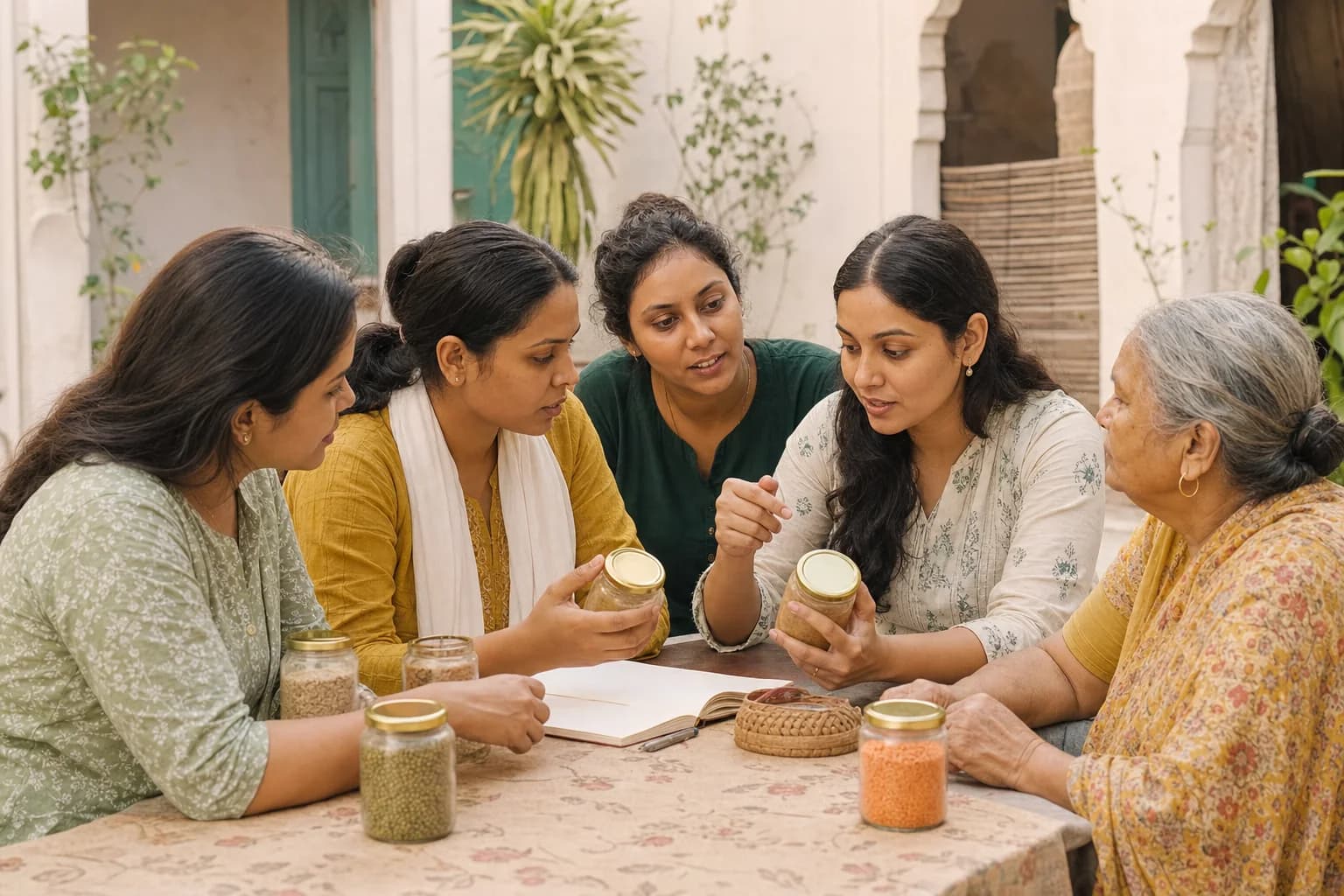
The women organising trust at the last mile: the short answer
Food trust is built not only on farms and in labs, but in the conversations where households ask practical questions. This article describes the operating questions for a women-led community food network. It does not claim that Zaivik’s proposed Annapurna model has already delivered named incomes or outcomes.
A systems profile, not a borrowed testimonial
This article describes the operating questions for a women-led community food network. It does not claim that Zaivik’s proposed Annapurna model has already delivered named incomes or outcomes. Those claims require real participants, consent, role records and a transparent earnings method.
The opportunity is still substantial. Women’s self-help groups across India already organise savings, credit, livelihoods and local services under programmes such as DAY-NRLM. A food-information role can build on community trust, but only if it is designed as skilled work rather than unpaid enthusiasm wrapped around a sales target.
No name, quotation, income or impact figure will be attributed to Zaivik’s programme before verification and consent.
Trust work is more than selling
A community organiser may explain a label, collect household questions, demonstrate storage practices, record a complaint, coordinate a meeting or help a family locate batch information. These tasks require product knowledge, communication skill and clear boundaries. She should be able to say “I do not know; I will check.”
If compensation rewards only units sold, difficult questions become inconvenient. A healthier model recognises education, feedback quality, attendance, service and responsible referral alongside any commercial activity. The public interest and the income model must not pull in opposite directions.
Training should include the limits of a claim
Training needs plain-language modules on licence and label information, organic and practice claims, batch identity, test scope, storage, complaint escalation and privacy. It should include role-play for questions such as “Does residue-free mean nothing was sprayed?” and “Is A2 ghee healthier?”
The correct answer may be narrower than the shopper expects. A residue result belongs to a sample, panel and threshold; A2 describes milk protein while ghee is mostly fat. An organiser earns trust by protecting those distinctions, not by winning every conversation.
Consent and data need everyday rules
Names, phone numbers, household preferences, health questions, photographs and earnings are personal data. Collection should be limited to a clear purpose, stored securely and shared only with appropriate permission. A customer must be able to ask a question without becoming a marketing lead by default.
The organiser’s own story also requires consent. Approval should specify whether a name, image, village, quote and financial detail may be published, and withdrawal must be practical. “Community story” is not a blanket release form.
How the feedback loop can improve food information
Repeated household questions can reveal where packaging or website language is failing. If people keep confusing a batch test with universal safety, the solution is not to train the community to repeat the claim louder. The brand should rewrite the explanation.
A structured loop can tag questions, response time, unresolved issues and product batches without exposing the person who asked. Serious complaints should move into a traceable escalation route. Closing the loop means telling the organiser what happened, so the next answer is informed by evidence rather than rumour.
What success should look like
A credible pilot would publish role descriptions, training completion, compensation logic, grievance routes, consent practice and service metrics. Income reporting should state the period, costs and number of active participants rather than presenting the best performer as an average.
The human outcome is delightfully simple: a skilled woman is paid fairly for useful work, a household receives an honest answer, and the brand learns where it must improve. That is a last mile worth organising—and a story worth waiting to document properly.
Sources and evidence
Primary material comes first. Brand standards are labelled separately from external evidence.
Tell us. Material corrections are dated and recorded, not silently overwritten.
Read our corrections policy